


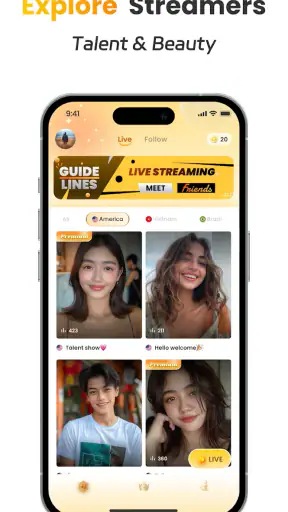

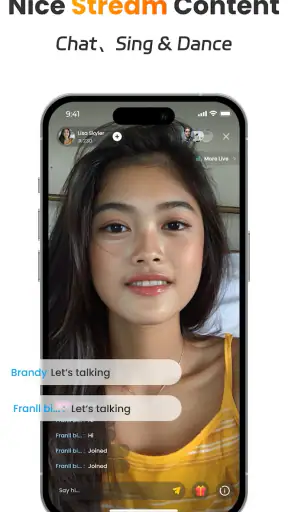
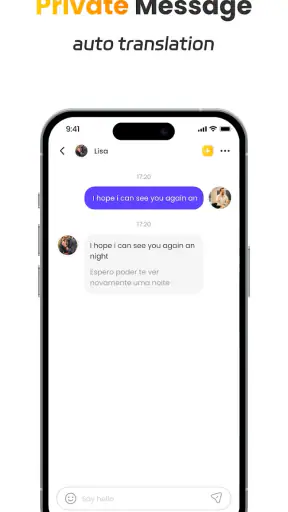
YahLive-Go Live in a Tap is an entertainment app from FANLCO TECHNOLOGY LTD that I would describe as a live social viewing experience rather than a simple video player. Its promise is easy to understand: open the app, find live content, and spend time with people or broadcasts that make the world feel a little closer. In practice, that kind of app succeeds or fails on more than the number of streams available. I pay attention to how clearly the app explains its choices, how much control I have over my account, and whether the experience feels comfortable when I am sharing attention, messages, or money.
My overall impression is mixed in a useful way. YahLive is approachable and free to install, so it is easy to test without committing to a subscription. At the same time, its mature audience positioning means I would not treat it as a casual app for every member of the household. The experience makes more sense for adults who already enjoy live social entertainment and are willing to spend a few minutes checking their privacy and account settings before settling in.
What the app feels like in everyday use
The first thing I noticed is that YahLive is built around immediacy. A traditional streaming service usually asks me to choose a film, series, or recorded video. A live app asks a different question: what is happening right now, and do I want to join it? That difference changes the rhythm. I am not only selecting content; I am deciding whether I want an open-ended, unpredictable session.
That makes it useful in small gaps during the day. If I have a short break and do not want to begin a long episode, a live entertainment app can offer something more spontaneous. I can browse for a while, watch a broadcast, and leave without feeling that I abandoned a carefully structured story. The trade-off is that the quality of the experience depends more heavily on what is active at that moment.
A realistic use case would be an evening when I want background company while preparing dinner. YahLive can fit that situation better than a movie because I do not need to give it my full attention from the first minute. If a stream catches my interest, I can focus on it; if it does not, I can move on. I would still keep the phone away from food preparation and avoid treating a live app as something that should run unnoticed around children, especially with its Mature 17+ age classification.
The app is free, which lowers the barrier to trying it. That does not mean every part of the experience is cost-free: in-app purchases range from under a dollar to amounts approaching one hundred dollars for an individual item. I would therefore approach any purchase screen slowly, read the wording, and make sure the payment is intentional. The free entry point is appealing, but the spending side deserves the same attention I would give any social entertainment platform.
YahLive has reached more than five million installs and holds a 4.6 average from roughly twenty-two thousand ratings. Those figures suggest that the concept has found a substantial audience, but they do not tell me whether it will match my personal taste. Live platforms can be very different from one another even when they appear to offer similar browsing and social features. I would use the rating as a reason to investigate, not as a substitute for checking the app myself.
Why trust matters more in a live social app
With recorded entertainment, I can often judge the product from the catalog and playback quality. With live social entertainment, trust is broader. I may encounter public interactions, fast-moving conversations, profile decisions, and purchase prompts in the same session. That makes visible controls especially important. I want to know what I am choosing to share, what I can manage later, and how easily I can stop participating.
I do not assume that a polished interface automatically means strong privacy. My practical approach is to review the permissions shown during setup, decline anything that is not needed for the way I intend to use the app, and revisit the operating system's app controls afterward. If I only want to watch, I would be cautious about granting access that appears unrelated to viewing. The right choice depends on the exact permission request displayed on the device, so I would judge that screen itself rather than rely on general assumptions.
The same principle applies to account creation. If YahLive lets me browse before completing a full profile, I would begin with the least identifying setup that still provides the functions I want. I would avoid using a public username that reveals my real name, workplace, or location. If the app asks for profile details, I would consider which ones are genuinely useful for the experience and which ones I would rather keep private.
These are not dramatic steps, but they make a difference. The strongest habit with a live app is to separate watching from social exposure. I can enjoy a broadcast without immediately following every account, joining every conversation, or filling out a detailed profile. That slower approach gives me time to understand the community before making myself more visible.
Controls I would check before settling in
When I review an app like this, I look for practical controls rather than vague assurances. I want to know whether I can manage notifications, mute unwanted interactions, block accounts, report problematic behavior, and remove or edit profile information. I also check whether account settings are easy to find instead of being buried behind several unrelated menus.
Because the exact options can change with the app version and device, I would inspect the controls available in version 2.2.0 directly. I would not assume that a feature exists merely because similar platforms offer it. The useful question is simple: when something makes me uncomfortable, can I identify the control that changes it without searching through the entire app?
Notifications deserve special attention. Live services are designed to bring me back when something is happening, but constant alerts can turn a short entertainment session into an interruption loop. I would begin with only the notifications I consider useful, then reduce them if the phone starts feeling noisy. This is one of the easiest forms of user agency because it changes the app's presence in my day without requiring me to delete my account.
I would also check the purchase path before using any paid interaction. The listed range of in-app items is wide enough that an accidental tap could matter. I would confirm whether the device requires authentication for purchases, keep that protection enabled, and avoid storing payment details casually on a shared phone. If a younger person might use the device, I would use the operating system's purchase restrictions as an additional safeguard rather than relying on a verbal warning.
Another useful workflow is to create a personal stopping rule. For example, I might decide that I will watch first and only consider a purchase after I have closed the initial prompt and returned to the stream. That small pause helps distinguish genuine interest from the pressure of a fast-moving live moment. It is particularly helpful when the app is entertaining but unpredictable, because excitement can make spending feel more urgent than it really is.
Privacy-sensitive moments that deserve a pause
The most sensitive moments are usually not the first seconds after installation. They appear when the app asks me to become more social, more identifiable, or more financially involved. Starting a profile, interacting publicly, sending something paid, or responding to a direct invitation can all change the level of exposure. I prefer to make each decision separately instead of treating the initial setup as permission for everything that follows.
Live conversation can also create pressure to respond quickly. If a broadcaster or another user asks personal questions, I would remember that I can simply decline to answer. I would not share my address, workplace, travel plans, phone number, or private social handles with someone I only know through a stream. A friendly atmosphere can still contain strangers, and the live format can make boundaries feel less obvious than they are.
For viewers who mainly want entertainment, the safest pattern is passive first use: watch, learn how the interface works, and observe the tone of the community. After that, I can decide whether following, commenting, or participating adds genuine value. This is a more deliberate workflow than jumping into every interaction, but it gives me a clearer sense of whether YahLive feels welcoming or demanding.
The Mature 17+ classification is another reason I would keep the app separate from a child's device or profile. An age label is not a guarantee that every live moment will suit every adult, either. It signals that the service is intended for a mature audience, so I would use it in an appropriate setting and avoid presenting it as general family entertainment.
Data choices should be handled in the same careful spirit. I would read the privacy information and consent screens presented by the app, paying attention to whether choices are optional or required for a particular function. If a setting controls personalized recommendations, discoverability, or communications, I would choose based on how much convenience I want versus how much visibility I am comfortable with. I would not enable a broader choice simply because it is the default.
How much control does the user really have?
User agency is not only about privacy menus. It also includes the freedom to leave a stream, change attention, and avoid financial or social commitments. YahLive's live format should work best when I treat browsing as exploratory rather than obligatory. I can sample the experience, decide what deserves my time, and close the app when it stops being enjoyable.
That sounds obvious, but live services often use momentum effectively. A notification, an active conversation, and a purchase prompt can appear close together, making the session feel more urgent than a normal video app. My solution is to separate those actions: I watch without buying, review a profile before following, and adjust alerts only after I understand how frequently they arrive.
I would also keep my account recovery details current while avoiding unnecessary personal information in the public-facing parts of the profile. If the app provides account deletion or sign-out controls, I would want them to be accessible from the account area rather than requiring guesswork. If I decide the service is not for me, leaving should be a normal choice, not something I postpone because I cannot find the relevant setting.
For a shared tablet or family phone, I would use a separate device profile where possible and make sure payment authentication is not left open. This is a more important precaution here than with a basic offline entertainment app because social activity and purchases can happen in the same environment. I would also avoid leaving the app signed in on a device that other people regularly use.
There is a trade-off between a highly controlled experience and a lively one. If I turn off every notification, keep my profile minimal, and never interact, I may miss some of the social value that makes YahLive different from ordinary streaming. That is acceptable if privacy is my priority. The app should fit my boundaries, not persuade me to weaken them just to participate.
Where YahLive fits among familiar alternatives
Compared with a conventional streaming service, YahLive is more spontaneous and socially oriented. A subscription video platform is usually better when I want predictable quality, a known title, parental tools, and a viewing session that follows a fixed schedule. YahLive is more interesting when I want to discover what is happening now and do not mind that the experience may vary from one visit to the next.
Compared with short-video apps, the live format can feel more immediate and less edited. Short clips are efficient when I want quick entertainment with a rapid sequence of recommendations. YahLive is a better fit when I want to stay with one live moment for longer or feel closer to the person hosting it. The downside is that a live session may have slower stretches, uneven pacing, or a tone that is not right for me.
Compared with a private messaging app, YahLive is not where I would go for close, dependable communication. Messaging is better for people I know, clear boundaries, and conversations that do not depend on public discovery. YahLive makes more sense for entertainment around live personalities or communities, provided I am comfortable with the public and semi-public nature of that environment.
That comparison also clarifies who should skip it. I would not recommend YahLive to someone seeking only offline playback, a tightly curated family catalog, or a completely quiet app with no social pressure. I would also hesitate to suggest it to anyone who dislikes unpredictable content or has difficulty setting firm limits around in-app purchases.
On the other hand, I can see the appeal for adults who enjoy live interaction, want something lighter than a full film, and are comfortable exploring. The free price makes experimentation straightforward, while the mature age classification helps set expectations about the intended audience. I would recommend trying it with notifications and purchases controlled from the start, rather than accepting every default and sorting things out later.
Performance expectations and practical setup
YahLive requires Android 7.0 or later, which makes it accessible on many older Android devices. That is helpful if I do not own the newest phone, although live video can still be demanding in ways that the operating-system requirement alone does not reveal. My experience would depend on the device, connection, battery condition, and how long I leave a stream running.
For a smoother session, I would begin on a stable connection, keep the phone adequately charged, and close demanding apps if the device is older. I would avoid judging the service from a single weak-signal moment. Live playback is especially sensitive to interruptions, and a problem caused by the network can feel like an app problem even when the software itself is responding normally.
I would also use headphones in shared spaces and check the volume before opening a stream. This is a small practical detail, but live content can begin at a different volume from the last thing I watched. Headphones can improve concentration and reduce the chance of broadcasting private audio into the room, while still leaving me responsible for what I choose to hear.
The developer is FANLCO TECHNOLOGY LTD, and the current version is 2.2.0. I would keep the app updated through the official store so that I receive the version intended for my device. Updates can change layouts and controls, so after a major update I would quickly revisit notification, account, and purchase settings instead of assuming they remain exactly where I left them.
My cautious recommendation
After looking at YahLive as both an entertainment product and a trust-sensitive social app, I think it is worth trying for the right adult user. Its strongest quality is the live, open-ended character: it gives me something to explore when I want company or immediacy rather than a fixed program. The free installation makes that experiment low-risk financially, as long as I remember that paid items are available and can become expensive individually.
My recommendation comes with clear boundaries. I would use a minimal public profile, review the permissions and consent choices shown on my device, limit notifications, protect purchases with authentication, and avoid sharing personal details in live conversations. I would also keep the Mature 17+ classification in mind and treat the app as adult entertainment, not a family-friendly default.
The best way to use YahLive is deliberately: explore first, interact second, and spend only after a separate decision. That approach preserves the app's social energy without giving the live format control over my time, information, or wallet. If I wanted a predictable catalog or private communication, I would choose a different kind of app. If I wanted spontaneous live entertainment and was prepared to manage my boundaries, YahLive-Go Live in a Tap would have a reasonable place on my phone.
In short, YahLive-Go Live in a Tap is most convincing when I treat it as an adult live-social discovery app, not as a replacement for every other entertainment service. Its audience size and strong average rating make it worthy of attention, but my final decision would still come from the controls I can see, the community atmosphere I encounter, and whether the app respects the amount of participation I actually want to give.


